
From some years ago CAR-T therapy is being successfully used for relapsed or refractory B cell acute lymphoblastic leukemia (B-ALL) and B cell lymphoma (BCL). However, the sustained complete remission rate, after one year following CAR-T therapy, is less than 50% in these patients. In an attempt to better understand the underlying cellular and molecular features of CAR-T cell therapy leading to different patient outcomes Guerrero-Murillo et al (1) have analyzed the clonal kinetics using single-cell alpha/beta T cell receptor (TCR) sequencing (sc- αβTCR-seq) integrated with the transcriptomics analysis using single-cell RNA sequencing (scRNA- seq). It has allowed them to explore the cellular dynamics in both non-transduced (CAR-negative) and transduced (CAR-positive) T cells purified by flow cytometry.
The study is done in 5 refractory/relapsed B-ALL adult patients treated with the CD19 CAR-T product varnimcabtagene autoleucel (varni-cel). CAR-negative and CAR-positive T cell fractions were examined in the manufactured infusion products (IPs) and in peripheral blood (PB) samples at the CAR-T cell expansion peak following infusion.
The comparative analysis between the point previous to the infusion and the point of the cell expansion revealed an unexpected finding: cytotoxic CAR-positive γδ T cells were found expanded in all patients at the expansion peak. Furthermore, the extent of in vivo expansion of CAR-positive γδ T cells clearly correlated with the treatment efficacy. Surprisingly, in spite of that the amount of CAR-positive γδ T cells was very low in the infusion product, a clear in vivo expansion of between 2- and 100-fold was detected at the expansion peak. Remarkably, the two patients in the discovery cohort with a massive in vivo expansion of CAR-positive γδ T cells showed a more sustained clinical response.
In summary, in vivo expansion of CAR-positive γδ T cells appears linked to a more favorable treatment outcome in these B-ALL patients. In this study, beta repertoire was analyzed but not gamma/delta repertoire. Based on these results it seems that, in addition to alpha/beta repertoires, gamma/delta T cell repertoires should be analyzed to obtain a more complete picture of what is really being infused and what is really happening in vivo regarding CAR-T therapy.
Reference:
(1) Integrative single-cell multi-omics of CD19-CARpos and CARneg T cells suggest drivers of immunotherapy response in B cell neoplasias. Cell Reports Medicine 2024 Nov 19;5 (11):101803. doi: 10.1016/j.xcrm.2024.101803. 2024 Oct 28 https://pubmed.ncbi.nlm.nih.gov/39471818/
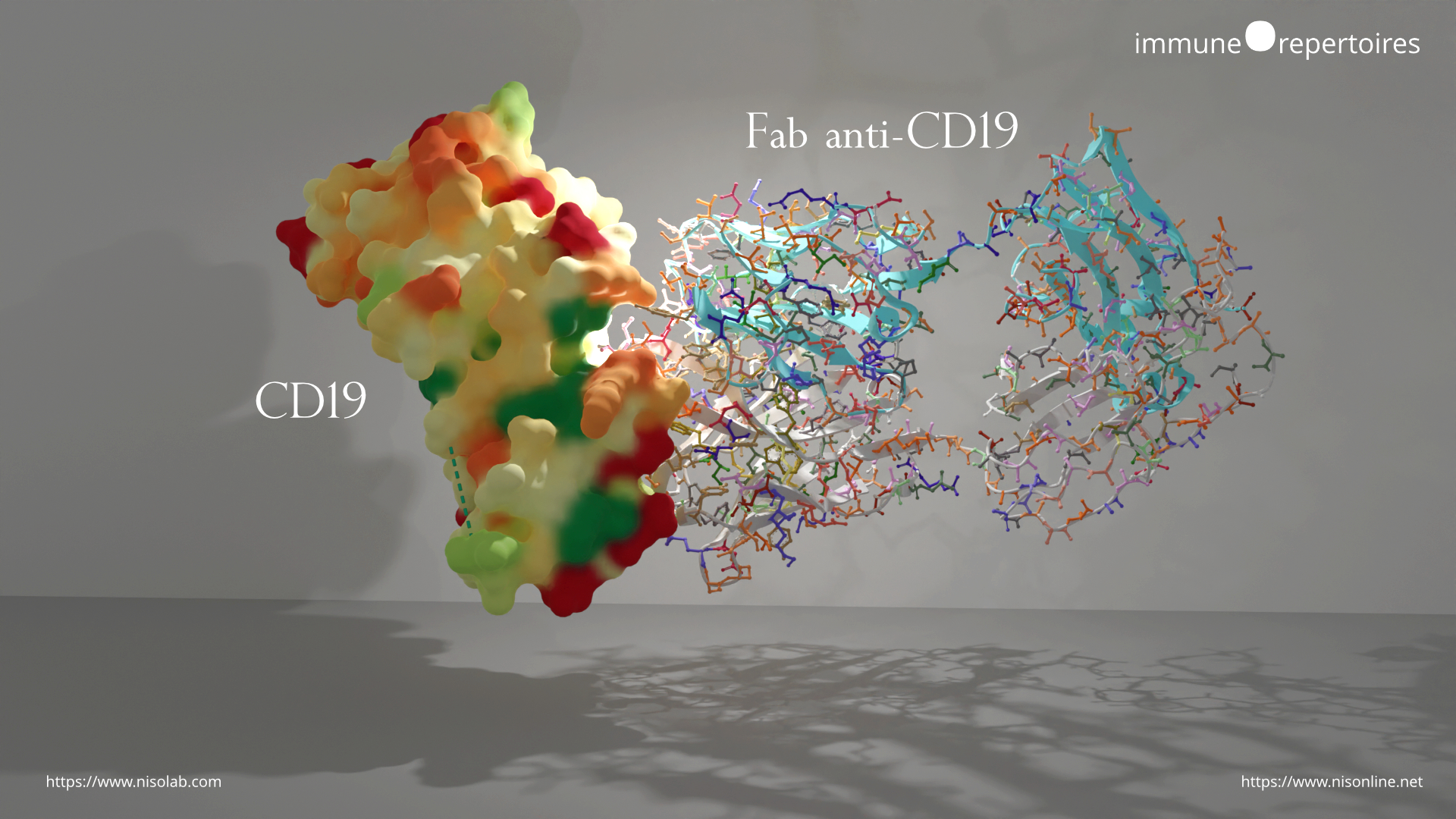
Picture: soluble CD19 (surface representation) bound to Fab anti-CD19 (cartoon and balls and sticks) https://nisonline.net/
Crystal structure PDB 7URX
ImmuneRepertoires can provide you gamma / delta , alpha / beta and single cell repertoire analysis